Showing posts with label rare pictures of space. Show all posts
Showing posts with label rare pictures of space. Show all posts
Tuesday, May 20, 2008

Sunday, May 18, 2008
"POLLEN LUNAR CORONA"

Tom King
Image taken:
May. 15, 2008
Location:
Watauga, Texas, USA
Details:
After seeing the beautiful solar pollen corona posted by Reinhard Nitze in Germany on Spaceweather.com today, I was astounded to see a colorful corona around the moon later the same evening in Texas! To borrow a line, "It appears the same pollen that makes you sneeze, and produces a solar corona, can also make a corona around the moon as well. Only this time when you sneeze...' Gesundheit! '...look for coronas near the moon too." Photo details: Canon EOS Digital Rebel, 400 ASA, 2s exposure.
"MOON"

siamak sabet
Image taken:
Mar. 30, 2008
Location:
KARAJ-TEHRAN-IRAN
Details:
Photo details: Canon EOS 350D digital camera Iso: 100 Tel: 66mm Apo Exposure Time: 5s
"MOON AND CLOUDS"


Mustafa Erol
Image taken:
May. 15, 2008
Location:
Antalya/TURKEY
Details:
First image: Canon EOS 350D digital camera, 200 ISO, 70mm APO DG lens, f/4 and 5s exposure. Next image: Canon EOS 350D digital camera, 100 ISO, 70mm APO DG lens, f/4 and 2,5s exposure.
"SOLAR PILLAR"

Lovely sunset over some hills close to my home in Manchester UK. A solar pillar was visible as the Sun got close to the hill. Image taken by Pentax Optio S50 digital camera.
"PERSEUS AND THE MEDUSA"

Erno Berko, Ludanyhalaszi, HUNGARYNov. 20, 2007
Perseus and the Medusa. The beautiful comet 17P near the Mirfak. The sky is very bright (80% Moon). 19:00(UT) The image made with 100mm/f6 refractor and Canon 350D camera. 10x80sec in IRIS.
"COMET HOLMES"
 Bill Williams, Chiefland Astronomy Village, FloridaNov. 9, 2007
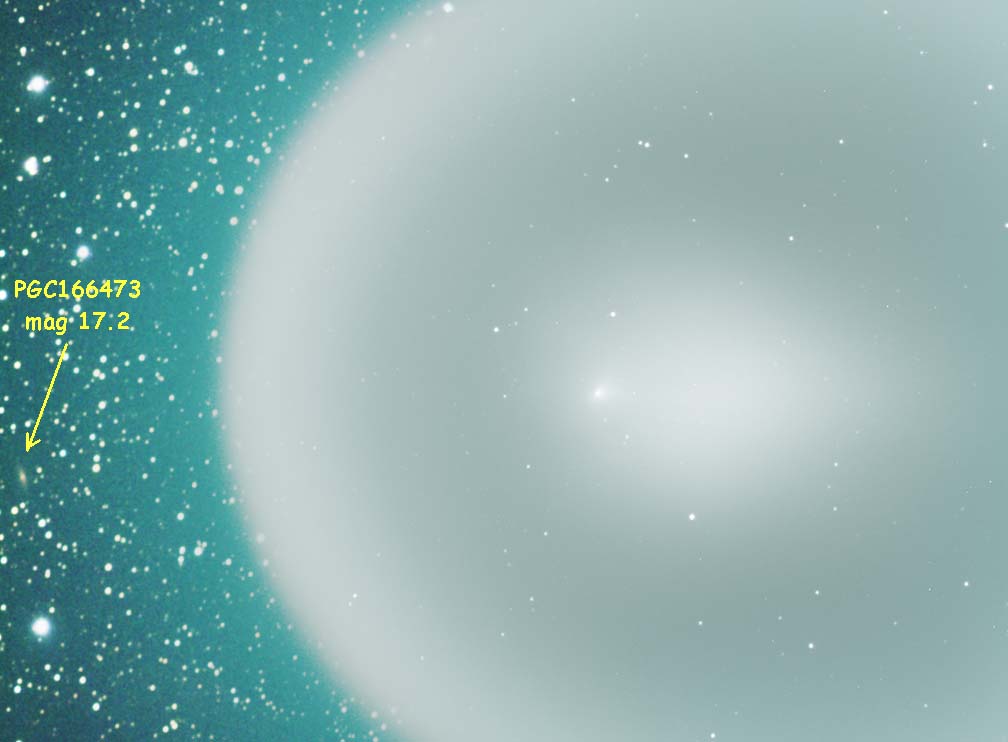
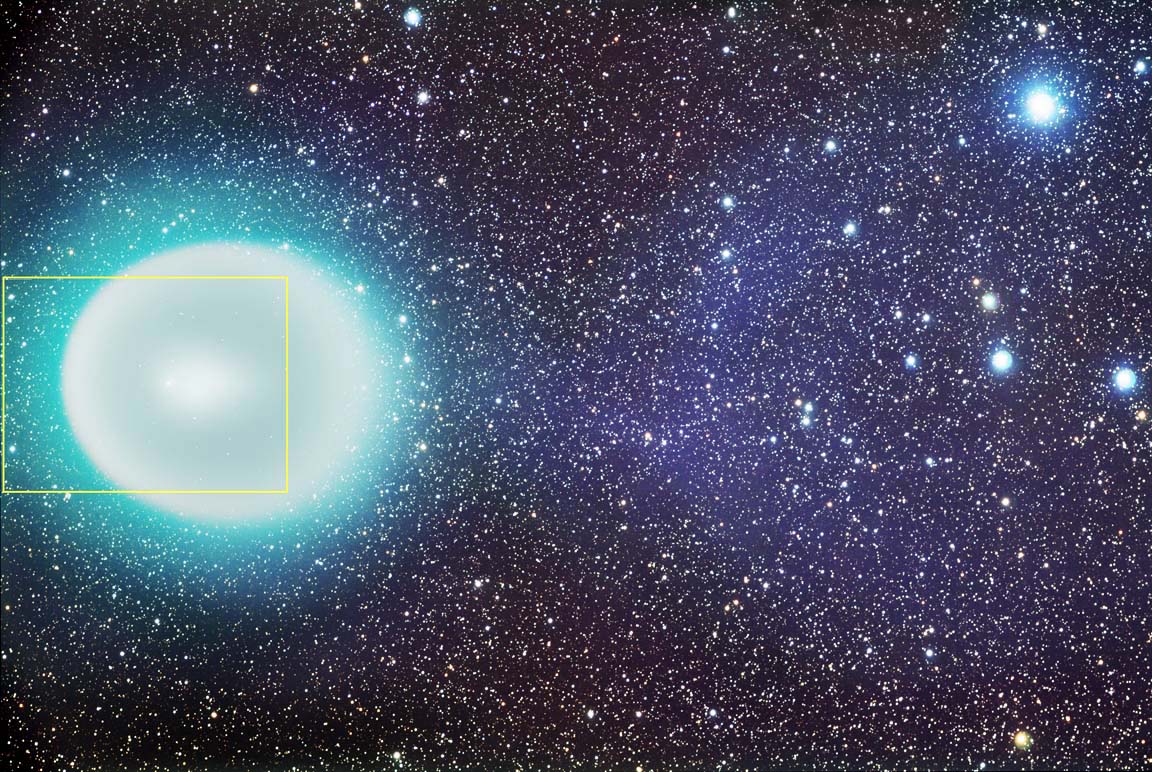
Comet Holmes Swallows Star" - a mere snack! This comet consumed a whole GALAXY, magnitude 17.2 PGC 166473 on Nov. 9, 2007 as seen in image #1. This distant galaxy resides at a distance of 200 million LIGHT YEARS shining feebly through the blue-green coma of Holmes at a neighborly distance of about 200 million MILES! Image #2 defines the field of image #1 (yellow box) when the tail detached approaching the star 34 Persei. Image #3 is a Sky Tools chart with Holmes' coma superimposed at the time it transited the PGC galaxy. Images were taken with 6-inch Astro-Physics refractor and STL-11K CCD camera.



"COMET HOLMES"

Today the moon was very bright. It was not easy to see the comet Holmes with the necked eyes. So, I create one picture of the moon and one of comet Holmes and create one out of two. Canon EOS 20D, focus distance 100/1000 refractor and 80/600 refractor. Moon 100 ASA/125 secondes, Comet Holmes 1600 ASA, 60 secondes Kind regards Günther
Saturday, May 17, 2008
"EUROPAS FROZEN SURFACE"

Europa, a moon of Jupiter, appears as a thick crescent in this enhanced-color image from NASA's Galileo spacecraft, which has been orbiting Jupiter since 1995.The view combines images taken in violet, green and near-infrared filters in 1998 and 1995. The colors have been stretched to show the subtle differences in materials that cover the icy surface of Europa. Reddish linear features are some of the cracks and ridges, thousands of kilometers long, which are caused by the tides raised by the gravitational pull of Jupiter. Mottled, reddish "chaotic terrain" exists where the surface has been disrupted and ice blocks have moved around. The red material at the ridges and chaotic terrain is a non-ice contaminant and could be salts brought up from a possible ocean beneath Europa's frozen surface.
"ENCELADUS"

Recent Cassini images of Saturn's moon Enceladus backlit by the sun show the fountain-like sources of the fine spray of material that towers over the south polar region. The image was taken looking more or less broadside at the "tiger stripe" fractures observed in earlier Enceladus images. It shows discrete plumes of a variety of apparent sizes above the limb of the moon. The greatly enhanced and colorized image shows the enormous extent of the fainter, larger-scale component of the plume.
"VENUS"
 This global view of the surface of Venus is centered at 0 degrees east longitude. Magellan synthetic aperture radar mosaics from the first cycle of Magellan mapping are mapped onto a computer-simulated globe to create this image. Data gaps are filled with Pioneer Venus Orbiter data, or a constant mid-range value. Simulated color is used to enhance small-scale structure. The simulated hues are based on color images recorded by the Soviet Venera 13 and 14 spacecraft. The image was produced by the Solar System Visualization project and the Magellan Science team at the JPL Multimission Image Processing Laboratory, and is a single frame from a video released at the October 29, 1991, JPL news conference.
"MARS BLUEBERRIES"
 This image shows an extreme close-up of round, blueberry-shaped formations in the martian soil near a part of the rock outcrop at Meridiani Planum called Stone Mountain. Scientists are studying these curious formations for clues about the area's past environmental conditions. The image, one of the highest resolution images ever taken by the microscopic imager, an instrument located on the Mars Exploration Rover Opportunity's instrument deployment device or "arm."
"VICTORIA CRATER ON MARS"
 This image from the High Resolution Imaging Science Experiment on NASA's Mars Reconnaissance Orbiter shows "Victoria crater," an impact crater at Meridiani Planum, near the equator of Mars. The crater is approximately 800 meters (half a mile) in diameter. It has a distinctive scalloped shape to its rim, caused by erosion and downhill movement of crater wall material. Layered sedimentary rocks are exposed along the inner wall of the crater, and boulders that have fallen from the crater wall are visible on the crater floor. The floor of the crater is occupied by a striking field of sand dunes.
"SATURN'S RINGS"

Saturn's A Ring From the Inside Out. The best view of Saturn's rings in the ultraviolet indicates there is more ice toward the outer part of the rings, than in the inner part, hinting at the origins of the rings and their evolution.
"HORSEBACK NEBULA"

This photo shows the famous "Horsehead Nebula", which is situated in the Orion molecular cloud complex. Its official name is Barnard 33 and it is a dust protrusion in the southern region of the dense dust cloud Lynds 1630, on the edge of the HII region IC 434. The distance to the region is about 1400 light-years (430 pc).This beautiful colour image was produced from three images obtained with the multi-mode FORS2 instrument at the second VLT Unit Telescope (KUEYEN), some months after it had "First Light". The image files were extracted from the VLT Science Archive Facility and the photo constitutes a fine example of the subsequent use of such valuable data.
"TARANTULA NEBULA"

At the center of the most violent starburst region in the local universe lies a cluster of brilliant, massive stars, known to astronomers as Hodge 301.Hodge 301, seen in the lower right hand corner of this image, lives inside the Tarantula Nebula in our nearest galactic neighbor, the Large Magellanic Cloud.This star cluster is not the brightest, or youngest, or most populous star cluster in the Tarantula Nebula -- that honor goes to the spectacular R136. In fact, Hodge 301 is almost 10 times older than the young cluster R136.
"MILKY WAY"
 This dazzling infrared image from NASA's Spitzer Space Telescope shows hundreds of thousands of stars crowded into the swirling core of our spiral Milky Way galaxy. In visible-light pictures, this region cannot be seen at all because dust lying between Earth and the galactic center blocks our view.
"PROFILE OF EARTH"

AS11-44-6689 Date Taken: 07/20/69 One-third of the Earth's sphere illuminated, Earth's terminator, sunglint, a portion of East Africa, as photographed from the Apollo 11 spacecraft during its lunar landing mission.
"SUNSET ON MARS"

A Moment Frozen in Time. On May 19th, 2005, NASA's Mars Exploration Rover Spirit captured this stunning view as the Sun sank below the rim of Gusev crater on Mars. This Panoramic Camera (Pancam) mosaic was taken around 6:07 in the evening of the rover's 489th martian day, or sol. Spirit was commanded to stay awake briefly after sending that sol's data to the Mars Odyssey orbiter just before sunset. This small panorama of the western sky was obtained using Pancam's 750-nanometer, 530-nanometer and 430-nanometer color filters. This filter combination allows false color images to be generated that are similar to what a human would see, but with the colors slightly exaggerated. In this image, the bluish glow in the sky above the Sun would be visible to us if we were there, but an artifact of the Pancam's infrared imaging capabilities is that with this filter combination the redness of the sky farther from the sunset is exaggerated compared to the daytime colors of the martian sky. Because Mars is farther from the Sun than the Earth is, the Sun appears only about two-thirds the size that it appears in a sunset seen from the Earth. The terrain in the foreground is the rock outcrop "Jibsheet", a feature that Spirit has been investigating for several weeks (rover tracks are dimly visible leading up to "Jibsheet"). The floor of Gusev crater is visible in the distance, and the Sun is setting behind the wall of Gusev some 80 km (50 miles) in the distance.
Subscribe to:
Posts (Atom)