Friday, August 20, 2010

CORONAL HOLE


CORONAL HOLE:
August 20. 2010
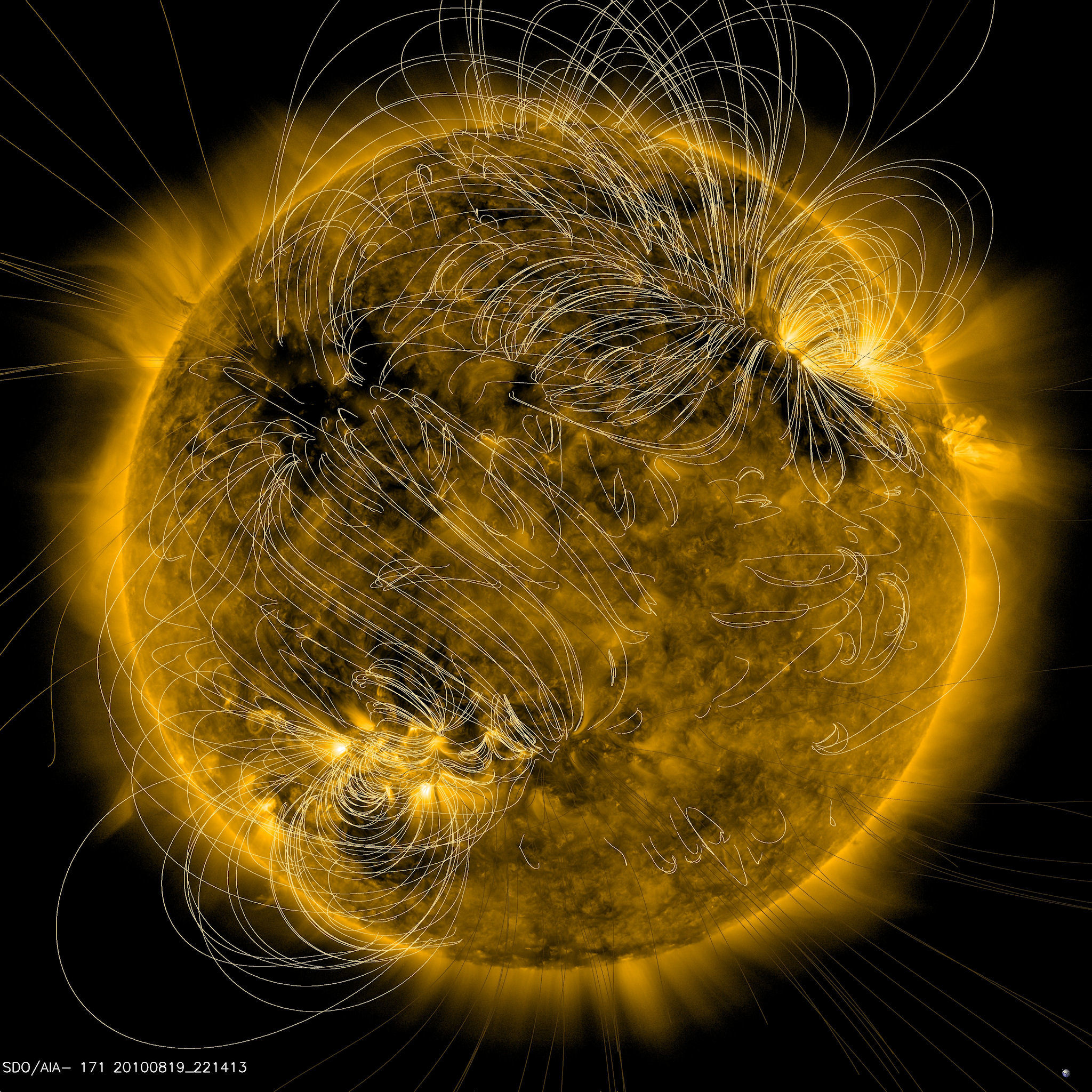
A coronal hole on the sun is turning to face Earth. Coronal holes are places in the sun's atmosphere where the magnetic field opens up and allows solar wind to escape. Here is a magnetic map of the hole from NASA's Solar Dynamics Observatory:
Image credit: Karel Schrijver, Lockheed Martin SAL
In the image, magnetic field lines are color-coded. White field lines are closed; they hold the solar wind in. Golden field lines are open; they allow the solar wind out.
A stream of solar wind flowing from this coronal hole is expected to reach Earth on or about August 24th. High-latitude sky watchers should
be alert for auroras when it arrives.

Sunday, August 1, 2010

NEW MEXICO FIREBALL

Dawn came early to New Mexico on Saturday around 4:54 am local time when a brilliant meteor exploded near Santa Fe. "It turned night into day," says amateur astronomer Thomas Ashcraft who recorded the fireball using an all-sky video camera: must-see movie. The movie's soundtrack is the signal from a 61 MHz forward-scatter meteor radar also operated by Ashcraft. Ghostly echoes from the meteor's debris continue long after the meteor itself explodes. Listen again.

HUGE SOLAR FLAIR


COMPLEX ERUPTION ON THE SUN: This morning around 0855 UT, Earth orbiting satellites detected a C3-class solar flare. The origin of the blast was sunspot 1092. At about the same time, an enormous magnetic filament stretching across the sun's northern hemisphere erupted. NASA's Solar Dynamics Observatory recorded the action:
Click to launch a 304 Å movie
The timing of these events suggest they are connected, and a review of SDO movies strengthens that conclusion. Despite the ~400,000 km distance between them, the sunspot and filament seem to erupt together; they are probably connected by long-range magnetic fields. In this movie (171 Å), a shadowy shock wave (a "solar tsunami") can be seen emerging from the flare site and rippling across the northern hemisphere into the filament's eruption zone. That may have helped propel the filament into space.
In short, we have just witnessed a complex global eruption involving almost the entire Earth-facing side of the sun.
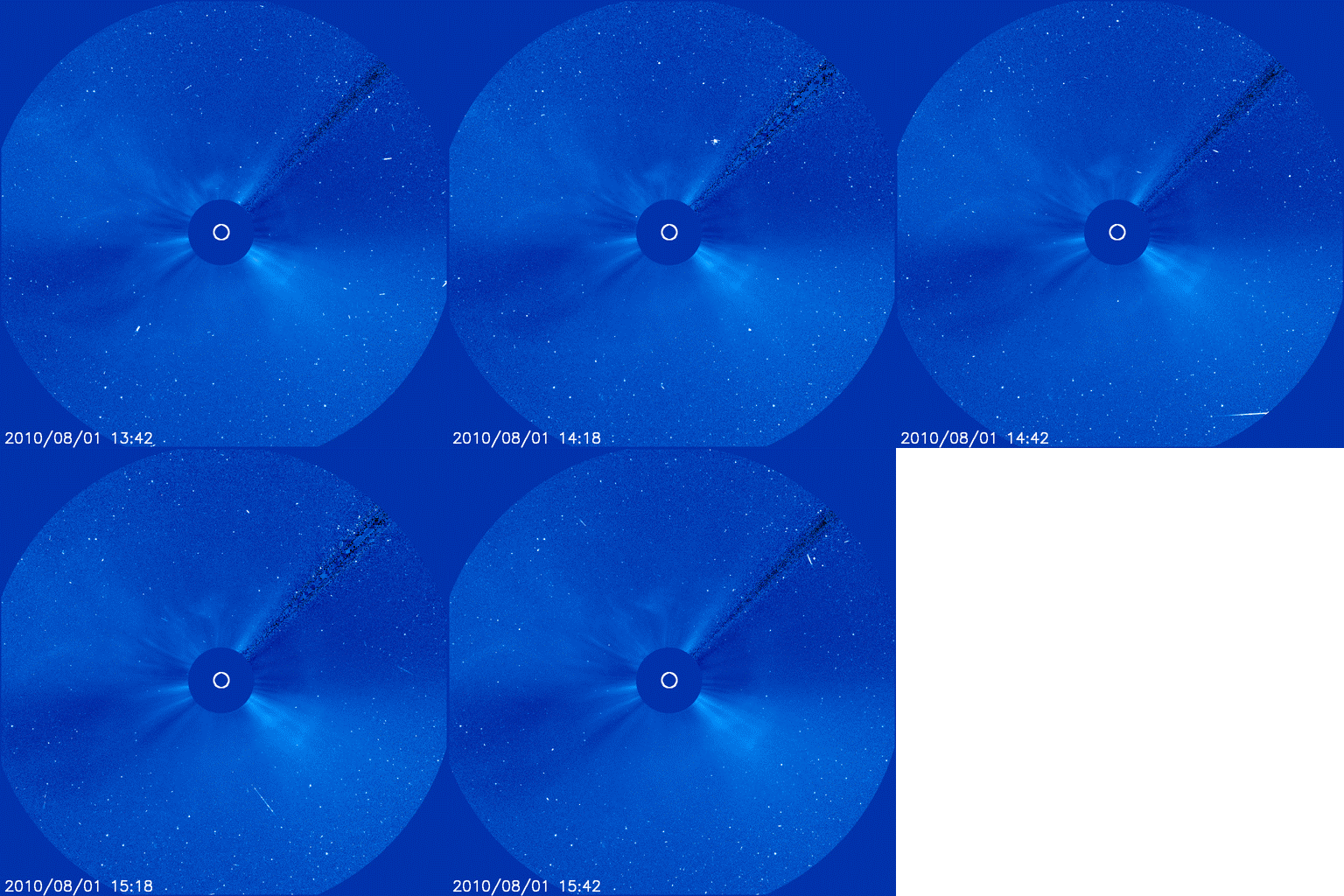
A coronal mass ejection (CME) produced by the event is heading directly for Earth: SOHO movie. High-latitude sky watchers should be alert for auroras when it arrives on or about August 3rd.
more images: from Francois Rouviere of Mougins, France; from Rogerio Marcon of Campinas SP Brasil; from Didier Favre of Brétigny-sur-Orge, France; from Cai-Uso Wohler of Bispingen, Germany; from Wouter Verhesen of Sittard, The Netherlands; from Michael Buxton of Ocean Beach, California

Friday, April 23, 2010

HUBBLE'S BEST SHOTS


PlutoTaken in 2002 and 2003, this is the most detailed and highest resolution image of the entire surface of the dwarf planet Pluto, a member of the population of bodies that reside in a part of our Solar System known as the Kuiper Belt. It is believed that the methane on Pluto's surface is broken up by the ultraviolet radiation from the sun, leaving behind a dark, carbon-rich residue..time.


Horsehead Nebula
Located approximately 1,500 light-years from Earth in the constellation Orion, this dark nebula is one of the most photographed and identifiable nebulae; its cloud dust and gases form what appears to be a horsehead in the night sky.

V838 Monocerotis
In the beginning of 2002, a dull star floating some 20,000 light-years away from the sun, in the constellation Monceros, experienced a major outburst that threw illuminating dust or 'light echos' into space, temporarily making it the brightest star in the Milky Way galaxy. Since its explosion, this mysterious star's apparent brightness has changed to mere obscurity.


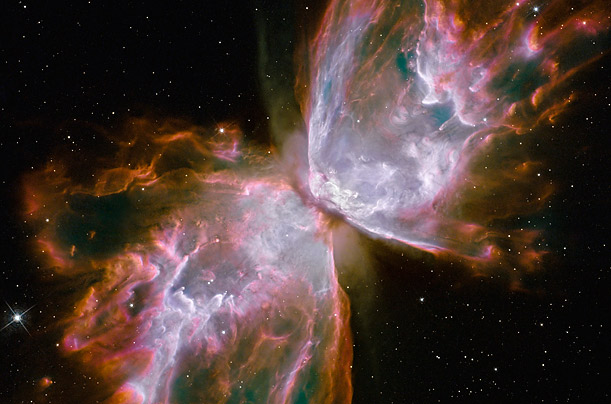
Butterfly Nebula


Also known as the Bug Nebula, the butterfly-shaped nebula consists of heated gas made up of oxygen and nitrogen, the whole of which tears through space at speeds in excess of 60,000 miles an hour. The dying star in the center is not unlike our sun.


Saturn Aurora


A large amount of solar wind activity from the sun creates a bright aurora around the south pole of the planet Saturn, rising more than a thousand miles above its cloud tops.

AN AWESOME VIDEO

http://science.nasa.gov/science-news/science-at-nasa/2010/21apr_firstlight/

INCREDIBLE PHOTOS OF THE SUN


"We've seen solar prominences before—but never quite like this," says Alan Title of Lockheed Martin, principal investigator of the Atmospheric Imaging Assembly (AIA), the observatory's main telescope array. "Some of my colleagues say they've learned new things about prominences just by watching this one movie."
SDO is the first mission of NASA's Living with a Star (LWS) program. The goal of LWS is to understand the sun as a magnetic variable star and to measure its impact on life and society on Earth. Program scientist Lika Guhathakurta of NASA headquarters envisions big things for the new observatory:
"SDO is our 'Hubble for the sun'," she says. "It promises to transform solar physics in the same way the Hubble Space Telescope has transformed astronomy and cosmology."
"No solar telescope has ever come close to the combined spatial, temporal and spectral resolution of SDO," adds Title. "This is possible because of the combination of 4096 x 4096-pixel CCDs with huge dynamic range and a geosynchronous orbit which allows SDO to observe the sun and communicate with the ground around the clock."


One of the most amazing things about the observatory is its "big picture" view. SDO is able to monitor not just one small patch of sun, but rather the whole thing--full disk, atmosphere, surface, and even interior. "We're going to make connections that were impossible in the past," says Title.
As an example he offers the events of April 8th:
With SDO looking on, decaying sunspot 1060 unleashed a minor "B3-class" solar flare. A shock wave issued from the blast site and raced across the surface of the sun (
movie). SDO images clearly show magnetic loops and other structures rocking back and forth when the wave passes over them. Eventually, the wave disappeared over the sun's horizon--but the show wasn't over. Four hours after the initial blast, and some 200,000 km away, a massive prominence erupted (image).
Coincidence? Not according to Title.
"As the wave swept across the surface of the sun, it de-stabilized magnetic fields it encountered en route. I believe the magnetic underpinnings of the prominence were upset by the wave, and this led to the eruption."
A seemingly insignificant B-flare triggered a massive prominence eruption halfway across the sun. This is the sort of unexpected connection that, when fully understood, could lead to big advances in space weather forecasting.
So far, SDO's prettiest pictures have come from the bank of telescopes called AIA. Other instruments on the spacecraft are working just as well—and they promise similarly exciting results.
"The Helioseismic Magnetic Imager (HMI) is performing splendidly," reports HMI principal investigator Phil Scherrer of Stanford University. "We're getting very high-quality, high signal-to-noise data."
HMI is designed to look inside the sun using a technique called helioseismology. Just as geologists use seismic waves to map the interior of our planet, solar physicists can use acoustic waves to map the interior of our star. On the sun, acoustic waves are generated by the sun's own internal motions. HMI detects the waves pulling the sun's surface back and forth, revealing indirectly what lies within.
"We're processing the data now," says Scherrer, "and soon we expect to have some nice maps of the sun's interior." The Extreme UV Variability Experiment (EVE) is online, too, "and we're getting great data as well," says principal investigator Tom Woods of the University of Colorado, Boulder.
EVE monitors the sun where it is most variable—in the extreme UV part of the electromagnetic spectrum. At these wavelengths, the brightness of the sun can rise and fall a hundredfold in the blink of an eye, heating and "puffing up" Earth's upper atmosphere, and dragging down satellites. EVE measures these changes with unprecedented time and spectral resolution.
"EVE has already detected a number of very interesting solar flares," says Woods. "We're excited; the flares evolved in a way we didn't expect. This is something we wouldn't have seen without the capabilities of EVE." He plans to offer more details at a later date when the EVE team has had time to fully analyze the data.
Mission scientists stress that all of this is preliminary. The observatory is still being commissioned, and a good deal of testing and calibration remains to be done before regular, daily images become available in mid-May. Even more effort must be put in before hard science appears in refereed journals.
"First Light is just a first look," says Pesnell. "The best is yet to come."
A complete gallery of SDO's First Light images and data may be found at http://svs.gsfc.nasa.gov/Gallery/SDOFirstLight.html.

Saturday, April 10, 2010

COMET CRASHES INTO OUR SUN


SUNGRAZING COMET:

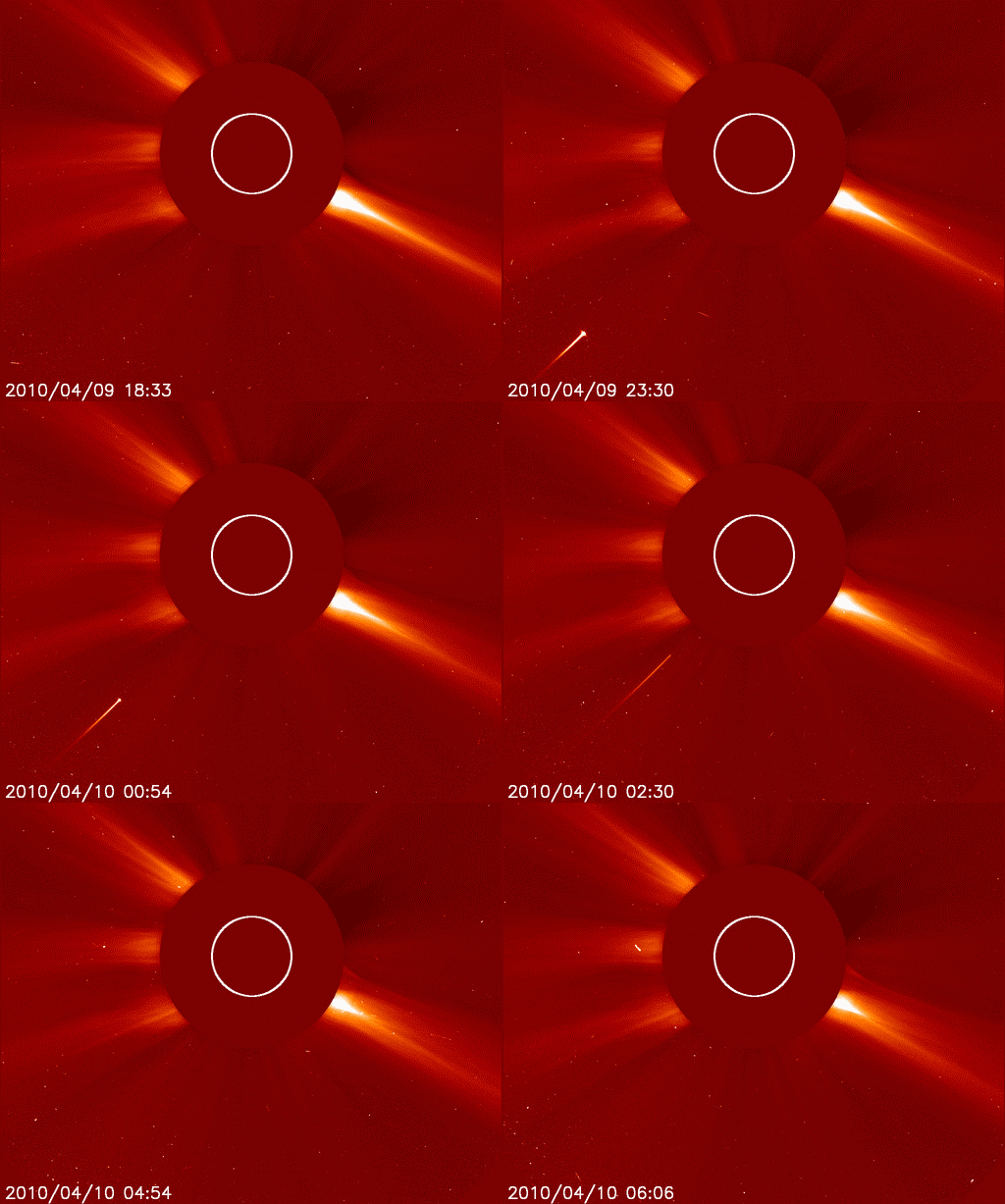
Today, the sun had a comet for breakfast. The icy visitor from the outer solar system appeared with no warning on April 9th and plunged into the sun during the early hours of April 10th. One comet went in, none came out. The Solar and Heliospheric Observatory (SOHO) had a good view of the encounter:
Click to launch a movie
The comet was probably a member of the Kreutz sungrazer family. Named after a 19th century German astronomer who studied them in detail, Kreutz sungrazers are fragments from the breakup of a giant comet at least 2000 years ago. Several of these fragments pass by the sun and disintegrate every day. Most are too small to see but occasionally a big fragment like today's attracts attention.
This has been an active year for big, bright sungrazers. There was one on Jan. 4th, one on March 12th, and now one today. Normally we see no more than 3 or 4 bright ones in a whole year; now we're seeing them almost once a month. It could be a statistical fluctuation or, maybe, a swarm of Kreutz fragments is nearing perihelion (closest approach to the sun). Stay tuned for doomed comets!