Tuesday, July 21, 2009

SUN PLUNGES UNTO THE QUIETES SOLAR MINIMUN IN A CENTURY


The sunspot cycle is behaving a little like the stock market. Just when you think it has hit bottom, it goes even lower. 2008 was a bear. There were no sunspots observed on 266 of the year's 366 days (73 percent). To find a year with more blank suns, you have to go all the way back to 1913, which had 311 spotless days. Prompted by these numbers, some observers suggested that the solar cycle had hit bottom in 2008.Maybe not. Sunspot counts for 2009 have dropped even lower. As of March 31st, there were no sunspots on 78 of the year's 90 days (87 percent). It adds up to one inescapable conclusion: "We're experiencing a very deep solar minimum," says solar physicist Dean Pesnell of NASA’s Goddard Space Flight Center in Greenbelt, Md. "This is the quietest sun we've seen in almost a century," agrees forecaster David Hathaway of NASA’s Marshall Space Flight Center in Huntsville, Ala. Quiet suns come along every 11 years or so. It's a natural part of the sunspot cycle, discovered by German astronomer Heinrich Schwabe in the mid-1800s. Sunspots are planet-sized islands of magnetism on the surface of the sun, and they are sources of solar flares, coronal mass ejections, and intense UV radiation. Plotting sunspot counts, Schwabe saw that peaks of solar activity were always followed by valleys of relative calm—a clockwork pattern that has held true for more than 200 years.> Click for larger imageThe sunspot cycle from 1995 to the present. The jagged curve traces actual sunspot counts. Smooth curves are fits to the data and one forecaster's predictions of future activity. Credit: David Hathaway, NASA/MSFC The current solar minimum is part of that pattern. In fact, it's right on time. But is it supposed to be this quiet? Measurements by the Ulysses spacecraft reveal a 20 percent drop in solar wind pressure since the mid-1990s—the lowest point since such measurements began in the 1960s. The solar wind helps keep galactic cosmic rays out of the inner solar system. With the solar wind flagging, more cosmic rays penetrate the solar system, resulting in increased health hazards for astronauts. Weaker solar wind also means fewer geomagnetic storms and auroras on Earth.Careful measurements by several NASA spacecraft have also shown that the sun's brightness has dimmed by 0.02 percent at visible wavelengths and a whopping 6 percent at extreme UV wavelengths since the solar minimum of 1996. These changes are not enough to reverse global warming, but there are some other, noticeable side-effects. Earth's upper atmosphere is heated less by the sun and it is therefore less "puffed up." Satellites in Earth orbit experience less atmospheric drag, extending their operational lifetimes. That’s the good news. Unfortunately, space junk also remains in orbit longer, posing an increased threat to useful satellites.> Click for larger image An artist's concept of NASA's Solar Dynamics Observatory. Bristling with advanced sensors, "SDO" is slated to launch later this year--perfect timing to study the ongoing solar minimum. Credit: NASA Finally, radio telescopes are recording the dimmest "radio sun" since 1955. After World War II, astronomers began keeping records of the sun's brightness at radio wavelengths, particularly 10.7 cm. Some researchers believe that the lessening of radio emissions during this solar minimum is an indication of weakness in the sun's global magnetic field. No one is certain, however, because the source of these long-monitored radio emissions is not fully understood.All these lows have sparked a debate about whether the ongoing minimum is extreme or just an overdue market correction following a string of unusually intense solar maxima. "Since the Space Age began in the 1950s, solar activity has been generally high," notes Hathaway. "Five of the ten most intense solar cycles on record have occurred in the last 50 years. We're just not used to this kind of deep calm."Deep calm was fairly common a hundred years ago. The solar minima of 1901 and 1913, for instance, were even longer than what we're experiencing now. To match those minima in depth and longevity, the current minimum will have to last at least another year. In a way, the calm is exciting, says Pesnell. "For the first time in history, we're getting to observe a deep solar minimum." A fleet of spacecraft — including the Solar and Heliospheric Observatory (SOHO), the twin probes of the Solar Terrestrial Relations Observatory (STEREO), and several other satellites — are all studying the sun and its effects on Earth. Using technology that didn't exist 100 years ago, scientists are measuring solar winds, cosmic rays, irradiance and magnetic fields and finding that solar minimum is much more interesting than anyone expected.> Click for larger imageThe "blankest years" of the past century. Vertical bars in this histogram represent the number of days in each year that the sun was blank--i.e., had no sunspots. Credit: Tony Phillips Modern technology cannot, however, predict what comes next. Competing models by dozens of solar physicists disagree, sometimes sharply, on when this solar minimum will end and how big the next solar maximum will be. The great uncertainty stems from one simple fact: No one fully understands the underlying physics of the sunspot cycle.Pesnell believes sunspot counts should pick up again soon, "possibly by the end of the year," to be followed by a solar maximum of below-average intensity in 2012 or 2013. But like other forecasters, he knows he could be wrong. Bull or bear? Stay tuned for updates.

MYSTERY SOURCE OF SOLAR WIND HEATING IDENTIFIED

Mystery Source of Solar Wind Heating Identified The solar wind, shown here in a plot of data from the Ulysses spacecraft, flows away from the sun at a million miles per hour and is heated by a "turbulent cascade." Credit: NASALarger ImageThe solar wind is hotter than it should be, and for decades researchers have puzzled over the unknown source of energy that heats it. In a paper published in the June 12 issue of Physical Review Letters, NASA scientists say they may have found the answer."The energy source is turbulence," says co-author Melvyn Goldstein, chief of the Geospace Physics Laboratory at NASA's Goddard Space Flight Center, Greenbelt, Md. "The sun heats the solar wind by stirring it up."

JUPITER HIT BY SOMETHING..THE SPOT BIGGER THAN EARTH

This image shows a large impact shown on the bottom left on Jupiter's south polar region captured on July 20, 2009, by NASA's Infrared Telescope Facility in Mauna Kea, Hawaii. Image credit: NASA/JPL/Infrared Telescope Facility


Scientists have found evidence that another object has bombarded Jupiter, exactly 15 years after the first impacts by the comet Shoemaker-Levy 9. Following up on a tip by an amateur astronomer, Anthony Wesley of Australia, that a new dark "scar" had suddenly appeared on Jupiter, this morning between 3 and 9 a.m. PDT (6 a.m. and noon EDT) scientists at NASA's Jet Propulsion Laboratory in Pasadena, Calif., using NASA's Infrared Telescope Facility at the summit of Mauna Kea, Hawaii, gathered evidence indicating an impact. New infrared images show the likely impact point was near the south polar region, with a visibly dark "scar" and bright upwelling particles in the upper atmosphere detected in near-infrared wavelengths, and a warming of the upper troposphere with possible extra emission from ammonia gas detected at mid-infrared wavelengths. "We were extremely lucky to be seeing Jupiter at exactly the right time, the right hour, the right side of Jupiter to witness the event. We couldn't have planned it better," said Glenn Orton, a scientist at JPL. Orton and his team of astronomers kicked into gear early in the morning and haven't stopped tracking the planet. They are downloading data now and are working to get additional observing time on this and other telescopes. This image was taken at 1.65 microns, a wavelength sensitive to sunlight reflected from high in Jupiter's atmosphere, and it shows both the bright center of the scar (bottom left) and the debris to its northwest (upper left). "It could be the impact of a comet, but we don't know for sure yet," said Orton. "It's been a whirlwind of a day, and this on the anniversary of the Shoemaker-Levy 9 and Apollo anniversaries is amazing." Shoemaker-Levy 9 was a comet that had been seen to break into many pieces before the pieces hit Jupiter in 1994. Leigh Fletcher, a NASA postdoctoral fellow at JPL who worked with Orton during these latest observations said, "Given the rarity of these events, it's extremely exciting to be involved in these observations. These are the most exciting observations I've seen in my five years of observing the outer planets!" The observations were made possible in large measure by the extraordinary efforts of the Infrared Telescope Facility staff, including telescope operator William Golisch, who adroitly moved three instruments in and out of the field during the short time the scar was visible on the planet, providing the wide wavelength coverage. JPL is managed for NASA by the California Institute of Technology in Pasadena.

Carolina Martinez 818-354-9382Jet Propulsion Laboratory, Pasadena, Calif.carolina.martinez@jpl.nasa.gov

Wednesday, June 17, 2009

SPACE WEATHER NEWS

Space Weather News for June 17, 2009

http://spaceweather.com

NIGHT-SHINING CLOUDS:
On June 16th, a remarkably intense display of electric-blue noctilucent clouds (NLCs) swept across Europe.
Sightings were made in Belgium, Denmark, the Netherlands, France, Germany, Poland and the British Isles.
These mysterious clouds are known to flourish during years of solar minimum--and 2009 is such a year.
This means more NLCs may be in the offing, not only over Europe but also North America and elsewhere.
Check http://spaceweather.com for images, movies, and observing tips.

THE MYSTERY OF THE MISSING SUNSPOTS:

The sun is in the pits of the deepest solar minimum in nearly a century.
Where have all the sunspots gone?
Scientists studying a jet stream deep inside the sun may have found the answer.
Find the full story at http://spaceweather.com

Friday, June 12, 2009

THE CRAB NEBULA


Hubble's image of the Crab Nebula shows a six-light-year-wide expanding remnant of a star's supernova explosion.
Japanese and Chinese astronomers witnessed this violent event nearly 1,000 years ago in 1054, together with, possibly, Native Americans.
The orange filaments are the remains of the star and consist mostly of hydrogen. The rapidly spinning neutron star embedded in the center of the nebula is the dynamo powering the nebula's eerie interior bluish glow.
The blue light comes from electrons whirling at nearly the speed of light around magnetic field lines from the neutron star.
The neutron star, the crushed ultra-dense core of the exploded star, ejects twin beams of radiation that appear to pulse 30 times a second due to the neutron star's rotation.

Sunday, June 7, 2009

STRANGE LIGHTNING

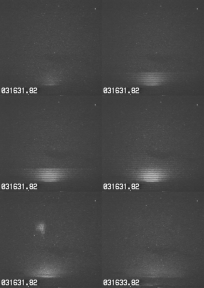
STRANGE LIGHTNING: High above Earth, in the realm of meteors and noctilucent clouds, a strange and beautiful form of lightning dances at the edge of space. Researchers call the bolts "sprites"; they are red, fleeting, and tend to come in bunches. Atmospheric scientist Oscar van der Velde of Sant Vicenç de Castellet, Spain, photographed this specimen on June 5th:

PLANET X NEXT TO THE SUN