
Wednesday, January 6, 2010

Monday, December 14, 2009
ICE CRYSTALS
 AFTER THE STORM: Last week, a powerful blizzard paralyzed parts of the US midwest. Mike Hollingshead of Blair, Nebraska, walked outside after the storm and this is what he saw;
Sunlight shining through ice crystals had produced a bright pair of sundogs and a vivid circumzenithal arc. "These tend to appear on the backside of a storm's clearing line as ice crystals blow through the air," notes Hollingshead. "It's a beautiful sight but not a ton of fun to photograph at 5o F with winds blowing 40 mph."
METEOR OVER NORWAY

Early this morning (Dec. 14th), Bjørnar G. Hansen photographed a Geminid fireball streaking through the Northern Lights over Kvaløya, Norway:
"I took the picture using a Nikon D3," says Hansen. "It is a 30 second exposure."
Robin Busscher sends this report from the Netherlands: "Between midnight and 2 am, we saw a big show of Geminids with as many as 5 meteors in only 10 seconds. That's a lot more than the predicted maximum of 140 per hour!"

"I took the picture using a Nikon D3," says Hansen. "It is a 30 second exposure."
Robin Busscher sends this report from the Netherlands: "Between midnight and 2 am, we saw a big show of Geminids with as many as 5 meteors in only 10 seconds. That's a lot more than the predicted maximum of 140 per hour!"
Thursday, December 10, 2009
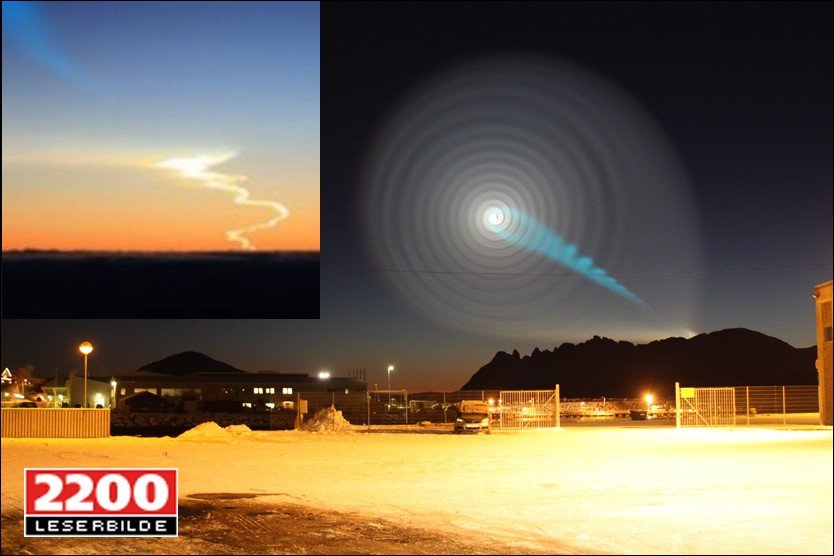
STRANGE LIGHTS OVER NORWAY:

Wednesday morning, Dec. 9th,
people in arctic Norway were stunned when a gigantic luminous spiral formed in the northern sky.
"We are used to seeing lots of auroras here in Norway, but this was different," says Nick Banbury of Harstad who witnessed the phenomenon on his way to work "between 7:50 and 8:00 a.m. local time."
Jan Petter Jorgensen took this photo:
The first reaction of many readers when they see this picture is Photoshop! Surely this must be a fake.
The first reaction of many readers when they see this picture is Photoshop! Surely this must be a fake.
But no, many independent observers witnessed and phtotographed the apparition. It is real.
Banbury continues: "It consisted initially of a green beam of light similar in color to the aurora with a mysterious rotating spiral at one end.
Banbury continues: "It consisted initially of a green beam of light similar in color to the aurora with a mysterious rotating spiral at one end.
This spiral then got bigger and bigger until it turned into a huge halo in the sky with the green beam extending down to Earth.
According to press reports, this could be seen all over northern Norway and must therefore have been very high up in the atmosphere to be seen hundreds of km apart."
HYPOTHESIS: Evidence is mounting that the phenomenon was caused by a malfunctioning suborbital rocket, possibly a Bulava ICBM launched from a Russian submarine in the White Sea.
HYPOTHESIS: Evidence is mounting that the phenomenon was caused by a malfunctioning suborbital rocket, possibly a Bulava ICBM launched from a Russian submarine in the White Sea.
A Navtex no-fly alert was issued for the White Sea on Dec. 9th, and photographers have recorded what appears to be the initial boost phase of a launch beneath the spiral (see inset). A rocket motor spinning out of control could indeed explain the spiral pattern, as shown in this video of a Trident II missile launched from a US submarine in 2007.
CONFIRMED:
The Russian Defense Ministry has confirmed the launch and subsequent failure of a submarine-based missile
Sunday, November 29, 2009
MOON DUST

Forty years ago, Neil Armstrong and Buzz Aldrin walked on the surface of the moon for the first time ever.
 The historic Apollo 11 Mission landed at the Sea of Tranquility, a large, dark basaltic lava flow
They returned to earth with samples of lunar rocks, sand, and dust

so scientists could search for clues to the origin of the moon and its geologic development

Since that time, microscopes have been greatly improved,

allowing us to see moon dust in ways that were not possible 40, 20 or even just a few years ago.
Saturday, November 28, 2009
THE HAND OF GOD

Hand of God
An X-ray nebula, spanning 150 light-years, swirls around a pulsar in a color-coded image captured by the Chandra X-ray Observatory satellite and unveiled April 3. The pulsar spews out blue-colored streams of particles that collide with a neighboring gas cloud, sparking orange-colored emissions. The blue streams have taken on the appearance of a hand with fingers and a thumb, and that has led some to nickname this image "the Hand of God."
An X-ray nebula, spanning 150 light-years, swirls around a pulsar in a color-coded image captured by the Chandra X-ray Observatory satellite and unveiled April 3. The pulsar spews out blue-colored streams of particles that collide with a neighboring gas cloud, sparking orange-colored emissions. The blue streams have taken on the appearance of a hand with fingers and a thumb, and that has led some to nickname this image "the Hand of God."

Green space
Starlight illuminates parts of the Orion Molecular Cloud with greenish light in this April 19 image, based on data from the United Kingdom Infrared Telescope and the Spitzer Space Telescope. The image is part of a survey charting a star factory in the constellation Orion. Energetic jets punch through the cloud and can be seen as a multitude of tiny pink-purple arcs, knots and filaments. The young stars that drive the jets are usually found along each jet and are colored golden orange.
Starlight illuminates parts of the Orion Molecular Cloud with greenish light in this April 19 image, based on data from the United Kingdom Infrared Telescope and the Spitzer Space Telescope. The image is part of a survey charting a star factory in the constellation Orion. Energetic jets punch through the cloud and can be seen as a multitude of tiny pink-purple arcs, knots and filaments. The young stars that drive the jets are usually found along each jet and are colored golden orange.
GALAXIES

One smooth galaxy
This image from NASA's Spitzer Space Telescope, showing the spiral galaxy known as NGC 2841, is helping astronomers solve one of the oldest puzzles in astronomy: Why do galaxies look so smooth, with stars sprinkled evenly throughout? An international team of astronomers has discovered that rivers of young stars flow from their hot, dense stellar nurseries, dispersing out to form the large, smooth distribution that we see in spiral galaxies like this one.
This image from NASA's Spitzer Space Telescope, showing the spiral galaxy known as NGC 2841, is helping astronomers solve one of the oldest puzzles in astronomy: Why do galaxies look so smooth, with stars sprinkled evenly throughout? An international team of astronomers has discovered that rivers of young stars flow from their hot, dense stellar nurseries, dispersing out to form the large, smooth distribution that we see in spiral galaxies like this one.
Subscribe to:
Posts (Atom)