Saturday, November 6, 2010

X RAY SOLAR FLARE


Active sunspot 1121 has just unleashed one of the brightest x-ray solar flares in several years, an M5.4-class eruption at 15:36 UT on Nov. 6th.
Radiation from the flare created a wave of ionization in Earth's upper atmosphere that altered the propagation of low-frequency radio waves.
There was, however, no bright CME (plasma cloud) hurled in our direction, so the event is unlikely to produce auroras in the nights ahead.
Visit http://spaceweather.com for a movie of the eruption and more information about this increasingly active sunspot.

So far none of the eruptions has been squarely Earth-directed, but this could change in the days ahead as the sun's rotation turns the active region toward our planet.

Now might be a good time to sign up for space weather alerts.

Monday, September 20, 2010

CLOSE ENCOUNTER WITH JUPITER:

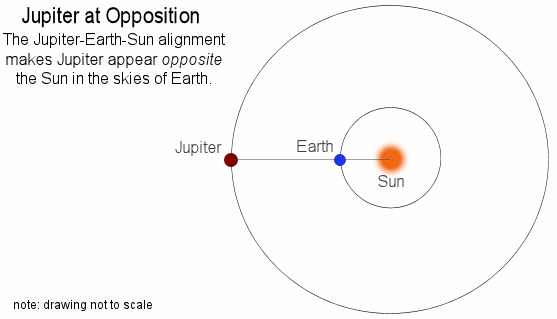
CLOSE ENCOUNTER WITH JUPITER: Tonight, Earth and Jupiter converge for their closest encounter until 2022. The giant planet will soar overhead at midnight, outshining everything except the Moon itself. At this time, even a small telescope pointed at Jupiter will reveal the planet's moons, cloud belts and swirling storms. Take a look!
If Jupiter is up at midnight, it must be opposite the sun: diagram. Indeed, astronomers call this "Jupiter's night of opposition." The effect of opposition may be seen in the shadow of Jupiter's moon Io, shown here in a photo taken last night by Anthony Wesley of Australia:

"Io was almost on top of its own shadow," points out Wesley. "This is due to the near-perfect alignment of Jupiter, Earth and the sun."
In a coincidence of interplanetary proportions, Uranus is also at opposition tonight. This rare double opposition of two giant planets is a once-in-a-lifetime event. Unlike Jupiter, Uranus is barely visible to the naked eye, a result of its smaller size and greater distance. It looks great, however, through a small telescope. Just point your optics at Jupiter and you will find emerald Uranus about 1o away.

Tuesday, September 7, 2010

Friday, August 20, 2010

AURORA BOREALIS


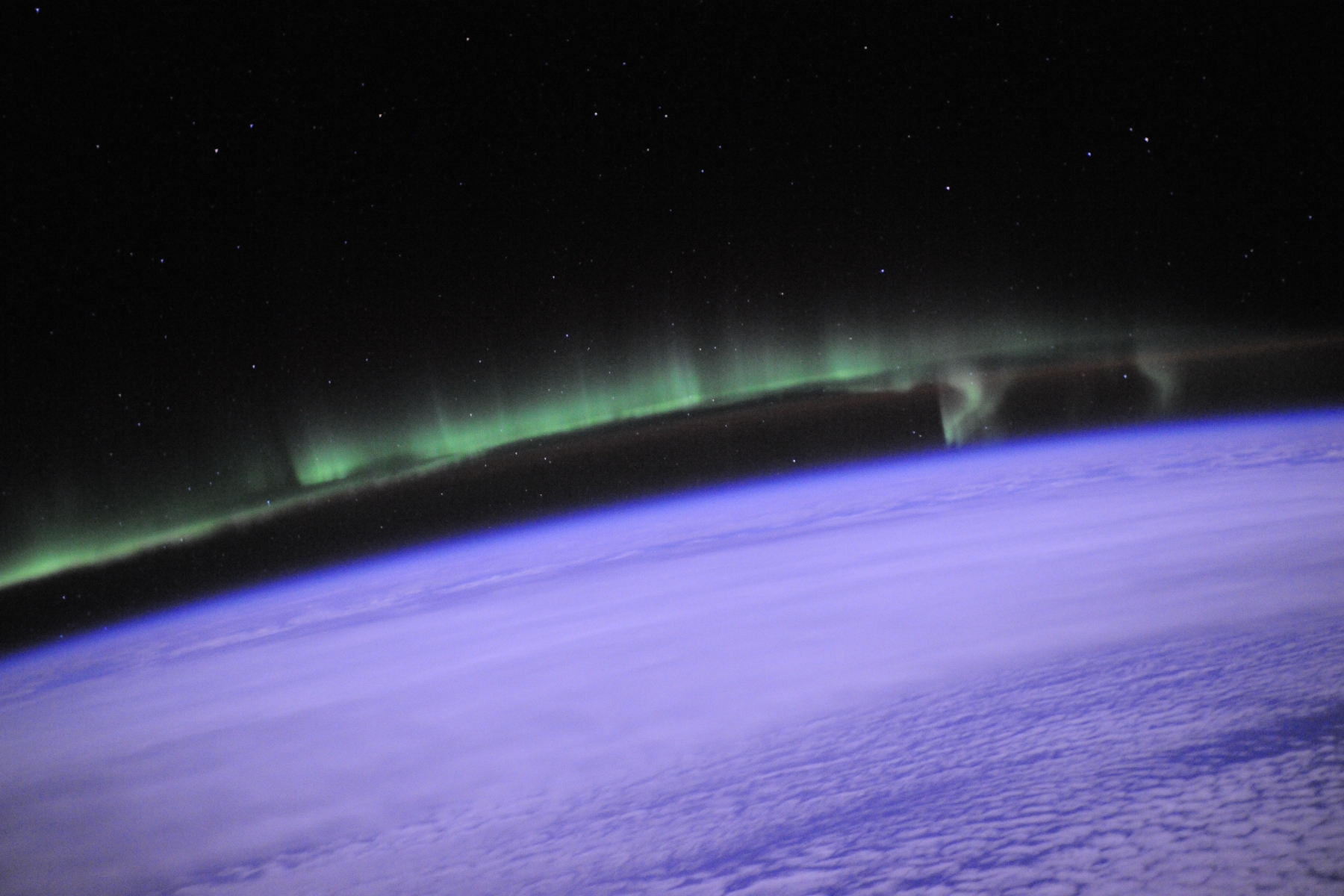
AURORAS UNDERFOOT: On August 13th a minor solar wind stream hit Earth's magnetic field. The impact did not trigger widespread displays of auroras on Earth, but the view from orbit was sublime:

NASA astronaut Doug Wheelock took the picture from the International Space Station and quickly tweeted it down to Earth, captioned by lyrics from the Don McLean ballad "Vincent" (aka "Starry Starry Night"). Note how the planet directly below the auroras is partially sunlit. The auroras are nevertheless visible against the black, starry backdrop beyond the planet's limb. The ISS is a nice place for sky watching!
Another solar wind stream is heading for Earth, due to arrive on August 24th (see "Coronal Hole," below). Stay tuned to
Wheelock's twitter feed for more aurora sightings from space.

CORONAL HOLE


CORONAL HOLE:
August 20. 2010
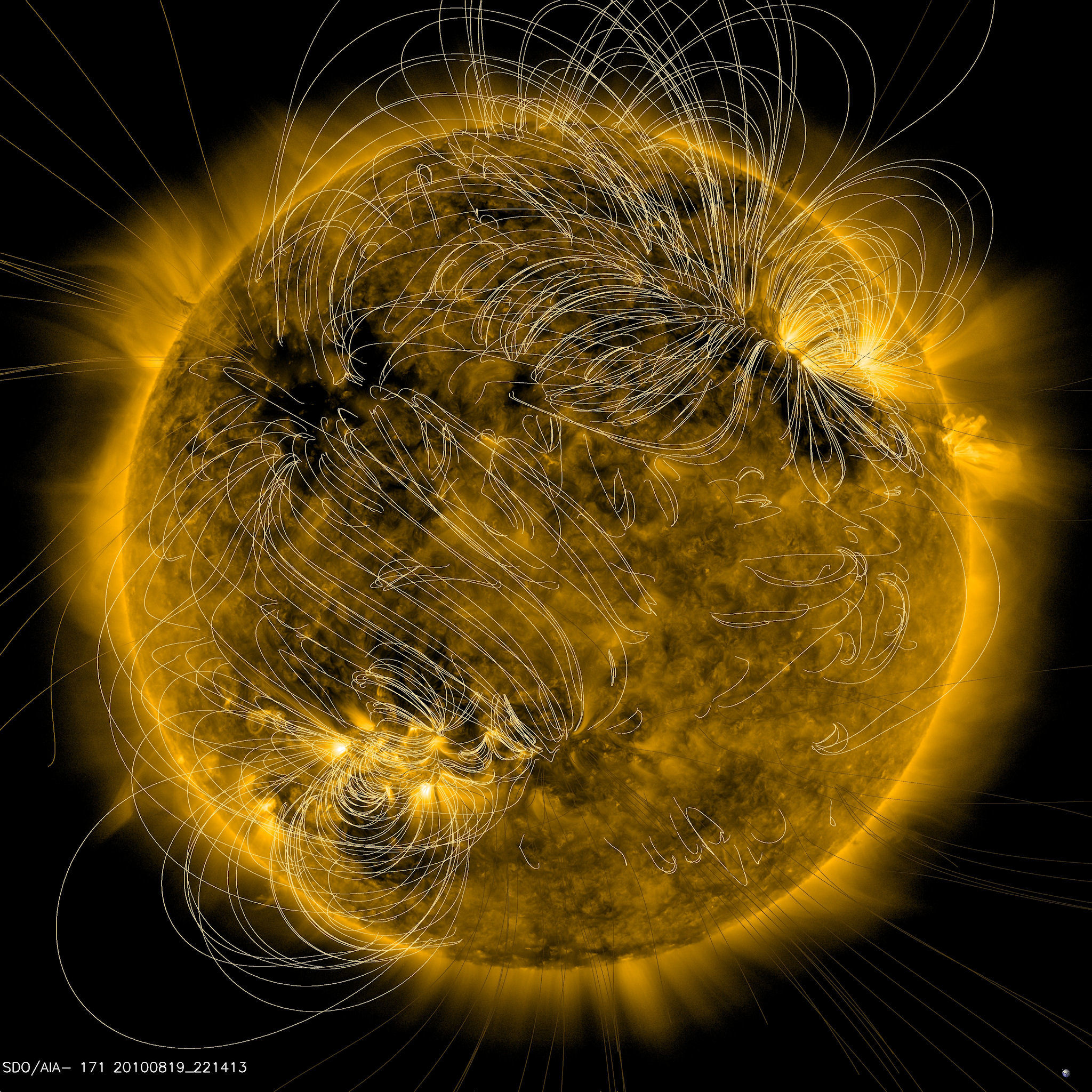
A coronal hole on the sun is turning to face Earth. Coronal holes are places in the sun's atmosphere where the magnetic field opens up and allows solar wind to escape. Here is a magnetic map of the hole from NASA's Solar Dynamics Observatory:
Image credit: Karel Schrijver, Lockheed Martin SAL
In the image, magnetic field lines are color-coded. White field lines are closed; they hold the solar wind in. Golden field lines are open; they allow the solar wind out.
A stream of solar wind flowing from this coronal hole is expected to reach Earth on or about August 24th. High-latitude sky watchers should
be alert for auroras when it arrives.

Sunday, August 1, 2010

NEW MEXICO FIREBALL

Dawn came early to New Mexico on Saturday around 4:54 am local time when a brilliant meteor exploded near Santa Fe. "It turned night into day," says amateur astronomer Thomas Ashcraft who recorded the fireball using an all-sky video camera: must-see movie. The movie's soundtrack is the signal from a 61 MHz forward-scatter meteor radar also operated by Ashcraft. Ghostly echoes from the meteor's debris continue long after the meteor itself explodes. Listen again.

HUGE SOLAR FLAIR


COMPLEX ERUPTION ON THE SUN: This morning around 0855 UT, Earth orbiting satellites detected a C3-class solar flare. The origin of the blast was sunspot 1092. At about the same time, an enormous magnetic filament stretching across the sun's northern hemisphere erupted. NASA's Solar Dynamics Observatory recorded the action:
Click to launch a 304 Å movie
The timing of these events suggest they are connected, and a review of SDO movies strengthens that conclusion. Despite the ~400,000 km distance between them, the sunspot and filament seem to erupt together; they are probably connected by long-range magnetic fields. In this movie (171 Å), a shadowy shock wave (a "solar tsunami") can be seen emerging from the flare site and rippling across the northern hemisphere into the filament's eruption zone. That may have helped propel the filament into space.
In short, we have just witnessed a complex global eruption involving almost the entire Earth-facing side of the sun.
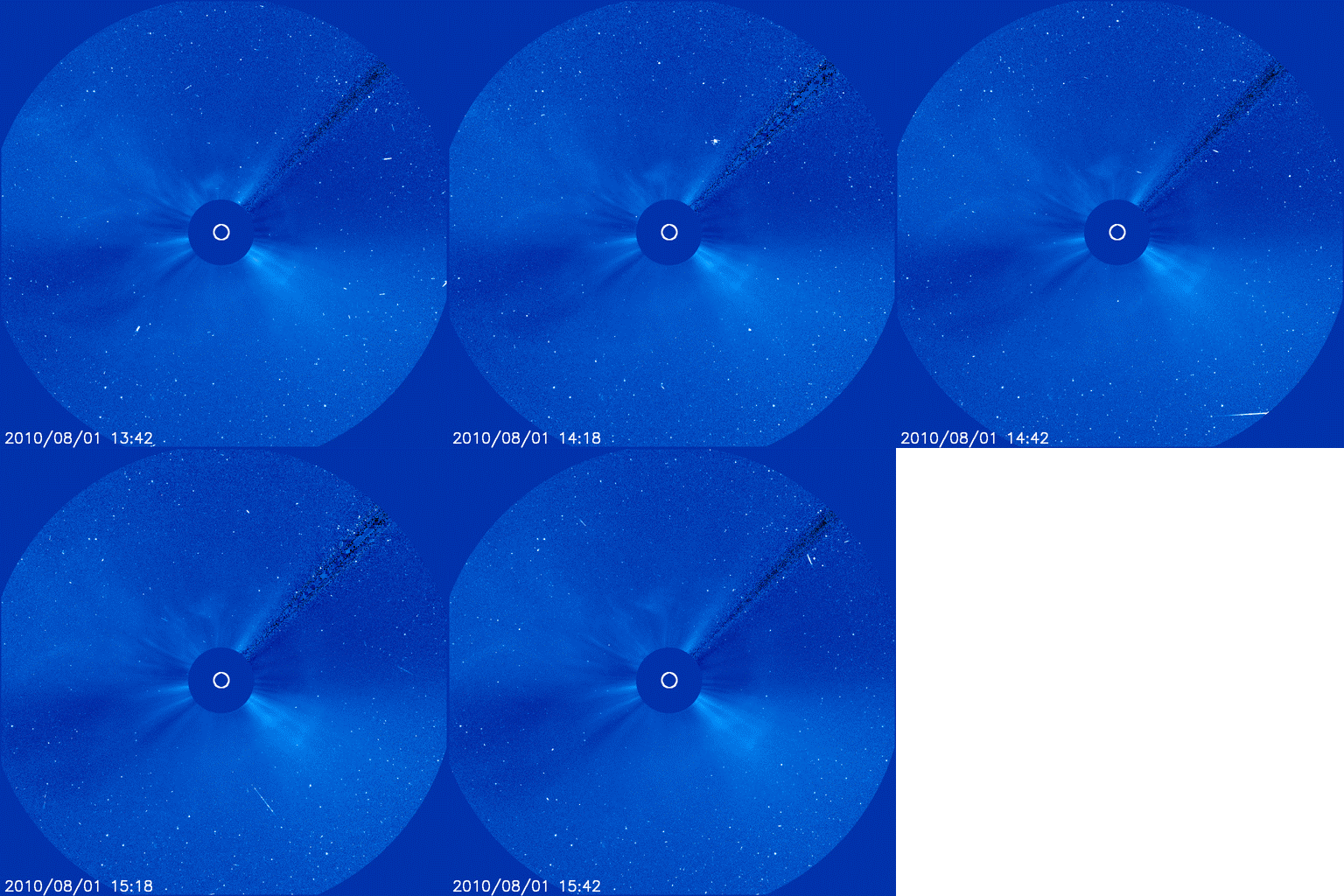
A coronal mass ejection (CME) produced by the event is heading directly for Earth: SOHO movie. High-latitude sky watchers should be alert for auroras when it arrives on or about August 3rd.
more images: from Francois Rouviere of Mougins, France; from Rogerio Marcon of Campinas SP Brasil; from Didier Favre of Brétigny-sur-Orge, France; from Cai-Uso Wohler of Bispingen, Germany; from Wouter Verhesen of Sittard, The Netherlands; from Michael Buxton of Ocean Beach, California